


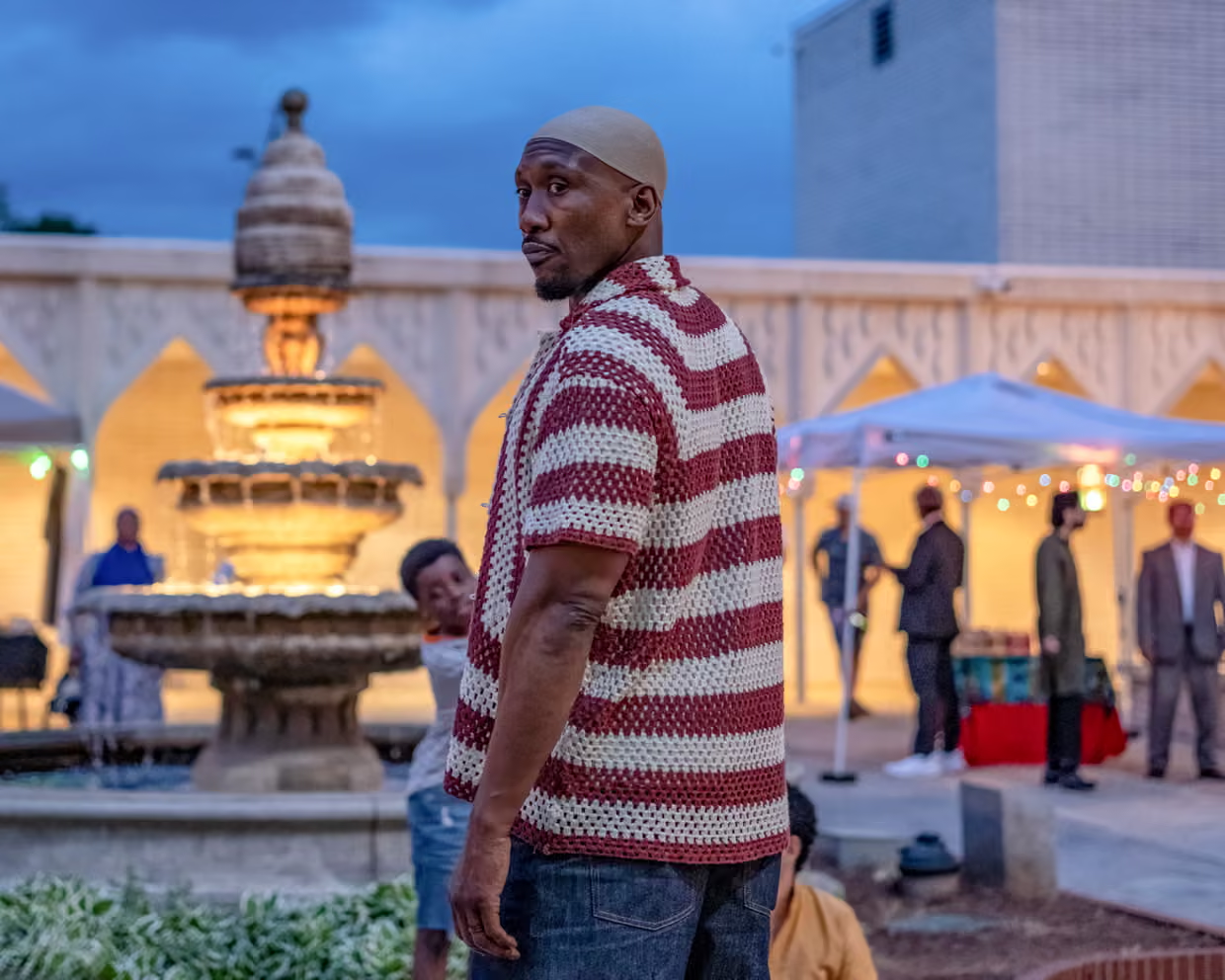

Mahershala Ali has been performing for roughly 30 years, but someway, no one had actually let him struggle. He appeared in The Hunger Games franchise and Alita: Battle Angel, yet the two-time Oscar winner typically discovered himself on the sidelines once the actual motion started. “I’ve been in a few action films, but I’ve tended to die as the action is starting as a character,” Ali says with a snort. In Bassam Tariq’s Your Mother Your Mother Your Mother, he finally gets his likelihood.
Ali performs Latif, a Muslim hitman making an attempt to shield his youngsters after the death of his spouse. He can deal with himself with a sword, but surviving the people pursuing him is only half of his downside. Latif is also struggling with his relationship to God, questioning how his work can coexist with his beliefs while making an attempt to stay current for a household dealing with its own grief. The contradiction gives Ali lots to wrestle with between fights, particularly as a Muslim and father himself.
The function also arrived through an uncommon bit of Hollywood historical past. Ali and Tariq initially deliberate to work collectively on Marvel’s Blade, and Ali spent appreciable time studying martial arts and sword work for the project. Their collaboration never reached the screen, but when Tariq later introduced him Your Mother Your Mother Your Mother, Ali discovered himself returning to expertise he had began developing years earlier. (“It was kind of like riding a bike,” he advised me regarding the voracity of his coaching.) This time, there was a completed movie ready on the other aspect.
Opening in theaters September 25, Your Mother Your Mother Your Mother finds Ali coming into territory he has needed to discover while still giving him the sort of sophisticated character he seeks. ESSENCE spoke with the actor about finally turning into an motion lead, reuniting with Tariq, discovering Latif through his own religion and what a script has to offer before Ali feels compelled to say yes.
ESSENCE: First of all—sensible movie—wonderful performances across the board.
Mahershala Ali: Thank you. I’m glad you got to see it.
So, I needed to ask you—what drew you to the movie Your Mother Your Mother Your Mother, and the character of Latif?
MA: Oh man, I think the scope of what that character is requested to do was very engaging to me. I think it was the proper of issue. I think anytime you act, you’re climbing a mountain or you’re working an uphill marathon. And so you’re wanting for the one that feels like the mountain you need to climb. And I just beloved I think all the emotional duties and duties of that character as properly as the alternative to be so bodily and to get to do the preventing and sword work. I’ve been performing 30 years primarily, and I’ve never actually got to do any motion. I’ve been in a few motion movies, but I’ve tended to die as the motion is beginning as a character. And so it was good to finally get to dwell to do the motion. And lastly I’ll say I had never learn anything like it.
It just felt deeply distinctive. And I think I really feel actually called to do issues that just in my life in basic, I sort of like them into issues that are a little less common. And I hadn’t seen this movie before.
I agree 100%, that what truly was my favourite half about it. Two issues: You spoke about the motion side first, so I can truly begin with that. What was the preparation course of for that?
MA: Well, Bassam [Tariq] and I had meant to do Blade collectively, so I began doing coaching in 2022 through 2023. And then when the strike occurred and all that sort of stuff type of went away, once I got this script, I need to say in 2024 into 2025, it was clear that if I was going to do the project that I was going to have to reengage with that skillset. Once I got back with Doniel Yehudah and a gentleman by the title of Enele Ma’afu, coaching with him, I think everything clicked back into place. So, I had about a month—I was coaching during Ramadan—but I had about a month to get prepared. And I only believe that was enough time because a couple years earlier I had spent so much time doing a bunch of sword work and martial arts coaching.
With Bassam slated to direct Blade as properly, what was the dialog between you two when this movie came around?
MA: Just in having a script, the story itself was just so distinctive and clear that all our focus was actually on Your Mother Your Mother Your Mother, purely. And I think clearly he knew and had seen me coaching, so I think in his thoughts, I don’t really feel like he questioned if I could do it per se. And Bassam would inform you, he had began working on this movie. I think he began writing it initially, I need to say around 2015, 16 or something. It was before we began working on Blade. And he had initially written the character with just my title. He had titled him Mahershala, according to Bassam.
So in us nearly working collectively and then truly getting to come back around each other and him truly having a script, in phrases of the preventing factor of it all, that actually wasn’t a query. It was just more of gauging my curiosity on this particular story of Latif and his journey. And of course I was actually in it. And there are parts from my own life that allowed me to relate to the character in phrases of him being Muslim and him being a father, and also just actually being in taking part in a character that I just hadn’t seen before. So it wasn’t something that I circled for very long in phrases of questioning if I needed to do it or not. I just had a few questions for him. But other than that, we sort of dedicated to it fairly shortly and actually tried to just get on the same web page in phrases of how to make it and how we saw the character.
The most intriguing half of this movie, to me at least, was the relationship between religion and morality. What you about that explicit dialog?
MA: Well, I don’t need to communicate for everyone, but I really feel like we can all wrestle with that. And I think half of religion and religion is to information your morality. And so to have a character who is deeply traumatized on some degree, but goes as far as to even actually confront and query God scared me a bit, but was also actually engaging from the standpoint of lending myself to another particular person’s journey. I think you have to ask yourself a lot of robust questions and be very sincere with yourself in the course of of making an attempt to get nearer to your creator. And I think Latif goes on that journey. He asks a lot of robust questions of himself and of God. But I also really feel like as a believer, you hope for, you nearly expect, but you actually hope for God’s grace.
Just from the outside wanting in, I felt assured about taking on that journey because I really feel like God is gracious, and ultimately Latif goes through a course of where he’s in a position to even give himself some grace.
…and out of all the forged members and the dynamic of each actor on the movie, I actually appreciated the dynamic between you and your daughter on the movie.
MA: Yes, Adia.
Yes, yes, yes. What was it like working with her and how did you construct that dynamic on screen?
MA: Adia was great to work with, as you could in all probability think about. What people may not know is she’s a midwife, so she works with birthing youngsters. And so there was a certain sort of data and awareness that she came in with and came ready to be the helper of a father who’s not too long ago lost his spouse. But just as another actor, just her skillset and honesty and earnestness and curiosity and willingness to commit and to be a great ally and companion was all on the floor. She came into the room offering all that up. So her and Jahleel [Kamara] were both great to work with. I would do it again at the drop of a hat, but it was very straightforward to uncover our chemistry collectively. She was sort of my proper hand all through that course of. I hope we were that for each other, but that relationship is so vital all through the movie. There is no movie without her and her character.
After all your accolades—particularly the two Academy Awards—I’m fairly sure you have a lot of issues that come across your desk; how are you mapping out your profession at this level?
MA: In phrases of that, I’m always wanting for the no-brainer, and they’re few and far between, which means the one that comes along and you go, “There it is. That’s it. There’s no question.” But I’m making an attempt to make sure I’m not repeating myself, though I’ve performed a lot of fathers, I guess, some methods, but I just think on some degree, I think in phrases of how the character’s journey unfolds or what he’s going for or what he’s experiencing, I need to make sure that it feels distinctive. You also need to make sure that filmmaking is so troublesome. I need to be sure that the story in some methods feels additive or productive for the tradition. I need it to imply something. And so it’s a bit of an investigation. Things come along and you get to sense it out.
Is it resonating with me? When I’m accomplished studying it, do I think about it again? Did I really feel excited going through the course of of studying that starting, center, finish story? Or is it something that in the finish of the day you’re just like, “Oh, I’m going to work with so-and-so and I’ll make some money.” And if that is the reply, it’s going to be a no. It’s just going to be a no. But it could be a million greenback film or a hundred million greenback film, it has to resonate.
It has to really feel like I have to do it, if that makes sense. And Your Mother Your Mother Your Mother felt like it was something that I had to do. And even on a deeper degree, it nearly felt like it was written for me in essence, where you can think about yourself in something and really feel like, “Yo, this is mine to take.” And so you hope to have those experiences as a artistic, as an actor, that even if something wasn’t, something could be meant for my good buddy, Sterling Ok. Brown or something. And for whatever purpose, he doesn’t do it and it comes your method and you go, “Oh man, this feels like this is for me.” Then if it feels that method in phrases of how it resonates, then it is for you. And so I think those are some of the issues that I look at.
It also has a lot to do with the time in your life, what is going on in your life and so many other parts that may entice you to a story. But in the finish, it felt like I had to do it, and that’s the feeling I’m wanting for is the factor that sticks. And I think if something sticks upon studying it, then it means that I have a likelihood. There’s a likelihood that if I execute it, it could finish up sticking with an viewers.
Source hyperlink


